
Quality Score is one of the most misunderstood numbers in Google Ads. Some advertisers obsess over pushing every keyword to 10. Others ignore it completely. Both miss the point: Quality Score is a diagnostic that tells you where your ads, keywords and landing pages are out of step with what searchers want.
In this guide I explain what Quality Score really measures, how it relates to what you pay per click, and the practical fixes I use to improve each component.
What is Quality Score in Google Ads?
Quality Score is a 1–10 rating Google Ads gives each keyword, estimating how relevant and useful your ads and landing page are to people searching for that keyword, compared with other advertisers. A higher score means your ad experience looks better than average for that keyword.
Two details matter:
- It is reported at the keyword level, in Search campaigns only.
- It is a diagnostic tool, not an auction input. Google says Quality Score itself is not used at auction time. The auction uses real-time quality signals that are related but calculated for each search, using far more context than a single number.
You may see "—" instead of a score. That usually means the keyword has not had enough impressions on exact searches for that keyword for Google to rate it.
What are the three Quality Score components?
Quality Score is built from three components: expected click-through rate, ad relevance and landing page experience. Each is rated as Above average, Average or Below average.
| Component | What it estimates | Main levers |
|---|---|---|
| Expected CTR | How likely your ad is to be clicked when shown for this keyword | Ad copy, assets, keyword-to-ad match, negatives |
| Ad relevance | How closely your ad matches the intent behind the search | Tight ad groups, headlines that reflect the keyword theme |
| Landing page experience | How relevant and useful the page is after the click | Message match, speed, mobile usability, clear next step |
To see them, add the columns Quality Score, Exp. CTR, Ad relevance and Landing page exp. to the keywords view. There are also historical versions of these columns, which let you see how scores changed over time for a selected date range.
The component ratings are more useful than the overall number. A keyword with a score of 5 and "Below average" landing page experience needs a different fix from a keyword with a score of 5 and "Below average" expected CTR.
How does Quality Score affect your cost per click?
Quality Score affects cost per click indirectly: the same ad-quality signals it summarises feed into Ad Rank, and better Ad Rank lets you win the same position at a lower cost, or a better position for the same bid.
Ad Rank decides whether your ad shows and where. It is based on your bid, the quality of your ads and landing page at auction time, Ad Rank thresholds, the context of the search, and the expected impact of your assets. The actual cost per click you pay is typically less than your maximum bid and depends on the Ad Rank needed to beat the advertiser below you.
So if your ad quality improves, you generally need less bid to achieve the same Ad Rank. That is where the "lower CPC" benefit comes from. I avoid promising specific savings, because the effect depends on competition and your starting point, but in competitive local markets, quality is one of the few levers that does not simply mean spending more.
How do you improve expected CTR?
You improve expected CTR by making your ad the most obviously relevant and appealing result for that specific search. That starts with showing ads only on the right searches.
- Clean up search terms. Irrelevant searches with low CTR drag the keyword down. Add negatives for job seekers, DIY, free and wrong services. My list of negative keywords for local service businesses is a good starting point.
- Use the keyword theme in headlines. If someone searches "move out cleaning", a headline that says "Move-Out Cleaning" gets attention.
- Give a reason to click. Same-day availability, a guarantee, transparent pricing or a free quote, as long as it is true.
- Use assets. Sitelinks, callouts, structured snippets, call assets and location assets make the ad larger and more useful.
- Check your match types. Very loose matching can bring in searches your ad does not really answer. See keyword match types explained.
How do you improve ad relevance?
You improve ad relevance by making sure each ad group covers one tight theme, so the ads in it can speak directly to every keyword it contains.
The most common cause of "Below average" ad relevance I find is an ad group that mixes unrelated keywords, such as "carpet cleaning", "office cleaning" and "window cleaning", served by one generic ad. No headline can be relevant to all three.
Practical fixes:
- Split broad ad groups into one service or product theme each.
- Write responsive search ads (RSAs) whose headlines reflect that theme, including variations of the main keyword.
- Avoid pinning every headline. Pinning one key headline is fine, but pinning everything limits Google's ability to match ads to searches.
- Pause or move keywords that do not fit the ad group's theme.
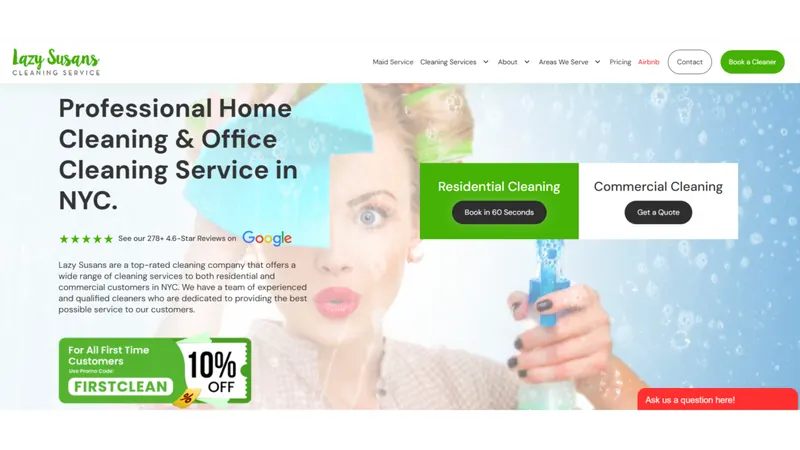
This service-based grouping is how I structured the Lazy Susan's Cleaning Service account, with keywords grouped by house cleaning, apartment cleaning, move-in/move-out cleaning and recurring cleaning, so each ad group could carry ads written for that service.
How do you improve landing page experience?
You improve landing page experience by sending each ad group to a page that delivers exactly what the ad promised, loads quickly and makes the next step obvious, especially on mobile.
Landing page checklist:
- The page headline matches the search and ad (message match)
- The service or product in the ad is clearly visible above the fold
- The page loads quickly on a mobile connection
- Text is readable on a phone without zooming
- Contact options are easy to find: a short form, a tap-to-call button, or both
- Contact details, service area and business information are clear
- No intrusive pop-ups that block content on load
- The page is crawlable, so Google can assess it
Sending every ad to your homepage is the classic mistake. A dedicated page per main service almost always helps both landing page experience and conversion rate. I go deeper in Google Ads landing pages that convert.
Which Quality Score myths should you ignore?
Some common beliefs about Quality Score are wrong or exaggerated:
- "Higher bids improve Quality Score." They do not. Bids and quality are separate inputs to Ad Rank.
- "Every keyword needs a 10." No. Focus on keywords with meaningful spend that show "Below average" components.
- "Pausing low-score keywords hurts the account." Quality Score is a keyword-level diagnostic, not an account-wide penalty, so removing an irrelevant keyword that wastes spend is usually a good thing.
- "Quality Score decides the auction." The reported score is a summary. The auction uses real-time quality signals instead.
How should you prioritise Quality Score work?
Prioritise by spend, not by score. Sort keywords by cost, then look at the components for your top-spending keywords first.
- Export keywords with cost, conversions and the three component columns.
- Filter to keywords responsible for most of your spend.
- Group them by the weakest component.
- Fix landing page issues first if many keywords share the same page, because one page fix lifts many keywords.
- Fix ad relevance by restructuring ad groups, then refresh ads.
- Recheck the historical columns after a few weeks.
Final thoughts
Quality Score is a helpful health check, not a goal in itself. Use the three components to find mismatches between searches, ads and landing pages, fix the ones that cost you most, and lower costs usually follow. If you want me to review your account, see my Google Ads management service or book a free audit.