If you run a US home service business, you have seen two kinds of ads at the top of Google: listings with a verification badge, star rating and "Call" button, and familiar "Sponsored" text ads linking to a website. The first are Local Services Ads. The second are Google Ads Search campaigns. Owners often ask me which one to choose, as if they were competing products.
They are not really competitors. They work differently, cost differently and suit different goals. This guide explains how each one works, where each one wins and how I decide what to run for cleaning, chimney, HVAC and renovation clients.
What is the difference between Google Ads and Local Services Ads?
The core difference is how you pay and how much control you get. Local Services Ads (LSA) charge per lead and match you to searches based on your business category, job types and service area. Google Ads Search campaigns charge per click and let you choose keywords, write ads, pick landing pages and set your own bidding.
| Local Services Ads | Google Ads Search | |
|---|---|---|
| You pay for | Leads (calls, messages, booking requests) | Clicks |
| Targeting | Category, job types, service area | Keywords, locations, audiences, schedule |
| Where people land | Your LSA profile | Your website or landing page |
| Ad copy | Generated from your profile | Written by you |
| Negative keywords | Not available | Full control |
| Verification | Required (varies by category and country) | Standard account and policy checks |
| Reporting | LSA lead dashboard | Full Google Ads reporting and conversion tracking |
Both are bought through Google, and LSA can be managed from within Google Ads in many markets, but they behave like two separate channels.
How do Local Services Ads work?
Local Services Ads work by showing a verified business profile to people searching for a service in your area, and charging you when a customer contacts you through the ad. You set a weekly budget, choose the job types and areas you serve, and Google decides when and where you appear.
What does verification involve?
Before your ads can run, Google screens your business. Depending on the category and country, this can include business registration, licences, insurance, and background checks on the owner or field staff. Once approved, your ad can show a badge. The badge names and programmes have changed over the years, with labels such as Google Guaranteed and Google Screened, and Google has been consolidating them in some markets. Check what applies to your category before you start, because screening can take time.
How does Google rank LSA profiles?
Google does not publish an exact formula, but it says ranking depends on factors such as your proximity to the customer, your reviews and rating, how responsive you are to leads, your business hours and the quality of your profile. In practice, the businesses that do well with LSA are the ones that answer the phone quickly, collect genuine reviews and keep their hours and service areas accurate.
What counts as a lead, and can you get credit for bad ones?
A lead is a call, message or booking request that comes through your LSA profile. Google has a process for crediting leads that are clearly invalid, such as spam or requests for services you do not offer, and that process has changed over time. Review your leads regularly, mark outcomes in the dashboard and check the current crediting rules in Google's help centre.
How do Google Ads Search campaigns work for local services?
Google Ads Search campaigns work by bidding on keywords people type, showing your text ad when your bid and ad quality are competitive, and charging you when someone clicks. You control almost everything: which searches you target, which you block, what the ad says and where the click goes.
That control is the main reason I still build Search campaigns for every home service client, even when LSA is running:
- You can push the services that make you the most money, such as move-out cleaning or chimney relining, instead of whatever job types Google matches you to.
- You can block job seekers, DIY searches and product searches with negative keywords for local service businesses.
- You can send people to a page built for that exact service, with a quote form and click-to-call.
- You can track forms, calls and offline sales, and let Smart Bidding optimise on real outcomes.
The trade-off is that you pay for clicks whether or not they turn into leads. Without good structure and tracking, a Search campaign can spend money on traffic that never calls.
When are Local Services Ads the better choice?
Local Services Ads are usually the better first step when you want phone leads quickly, your website is weak or non-existent, and your category and area are eligible. Because you pay per lead, a business with no landing page and no tracking can still get value from LSA.
LSA also fits well when:
- You have strong reviews and can answer calls fast during business hours.
- Your services map cleanly to the job types Google offers for your category.
- You prefer a simple setup and are comfortable with less control.
It is a weaker fit when you want to target specific high-value jobs, when your category is not eligible in your country, or when you need detailed reporting on which searches produced which jobs.
When is Google Ads Search the better choice?
Google Ads Search is usually the better choice when you need control, want to scale beyond what LSA delivers, or sell services that LSA job types do not describe well. It is also the only option when LSA is not available for your category or market.
Search campaigns suit businesses that:
- Have a decent website, or are willing to build service-specific landing pages.
- Want form leads as well as calls.
- Can invest in proper conversion tracking, including calls and offline conversions.
- Need to grow volume in specific services or areas.
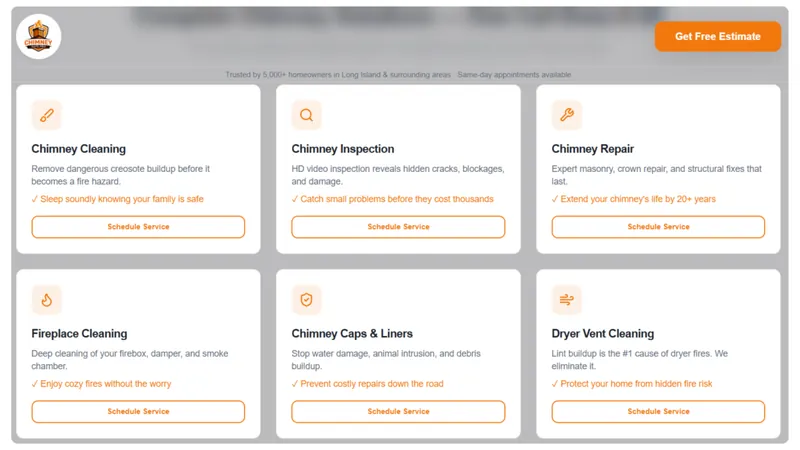
For Chimney Safe Pro, a Long Island chimney company, I built Search campaigns around high-intent cleaning, inspection and sweeping keywords, limited them strictly to the service area, and used negative keywords to filter out DIY, product and informational searches. That level of keyword control is something LSA simply does not offer.
Should you run both at the same time?
Yes, if you are eligible and have the budget, running both is usually the strongest option. They appear in different places on the results page, attract slightly different searchers and give you two chances to win the same customer.
A few rules I follow when running both:
- Keep the reporting separate. LSA leads live in the LSA dashboard; Search conversions live in Google Ads. Compare cost per lead side by side rather than mixing them into one number.
- Track calls properly on the Search side. Use call assets and website call conversions so you can compare like with like. My guide to Google Ads call tracking covers the setup.
- Use the same phone handling for both. If calls go unanswered, LSA ranking can suffer and Search leads are wasted.
- Let Search do the specific work. Use LSA for broad local demand and Search for the profitable, specific services you want more of.
- Review lead quality, not just volume. Mark LSA lead outcomes and import Search outcomes from your CRM where you can.
How do you decide where to start?
Start with the channel that matches what you have today. Here is a quick decision checklist:
- Is LSA available for my category and country? If not, start with Search.
- Can I pass screening and keep a strong review profile? If yes, LSA is worth setting up.
- Do I have a service page that converts? If not, LSA first while you build one.
- Do I want specific high-value jobs, not just any lead? Add Search.
- Can I track calls and forms reliably? If not, fix tracking before scaling Search.
There is no universal answer on which channel gives a lower cost per lead. It depends on your category, area, competition, reviews and account quality, so run both properly and compare your own numbers.
Final thoughts
Local Services Ads and Google Ads Search are two tools for the same goal: more booked jobs from local searches. LSA is simple and pay-per-lead; Search gives you control and room to grow. If you want help deciding or setting them up, see how I manage Google Ads for cleaning and home service businesses, or book a free audit.